
Stress Inversion for Fault-Slip Data after Angelier (1990)
Source:R/stress_inversion.R
slip_inversion_angelier.RdDirect inversion after the algorithm of Angelier (1990) with iterative refinement after Mostafa (2005)
Usage
slip_inversion_angelier(
  x,
  weights = NULL,
  max_iter = 100L,
  tol = NULL,
  n_psi = 361L,
  flip = FALSE
)
Arguments
- x
"Fault"object where the rows are the observations, and the columns the coordinates. Must have at least 4 fault measurements.- weights
numeric. Weightings for the faults. Must have the same length as
x- max_iter
integer. Maximum iteration count (default
50) for Mostafa (2005) optimization. Set to0for no optimization.- tol
numeric. Convergence tolerance on max absolute change in TR elements between iterations. Defaults to
getOption("structr.tol").- n_psi
integer. Number of psi grid points for each step (default
361)- flip
logical. Flip if you want to have the negative stress tensor, i.e. sigma 1 and 3 will be flipped.
Value
a named list with the following components:
sigma"ellipsoid"object. Best-fit devitoric stress tensor in input coordinate frameprincipal_axes"Line"objects. Orientation of the principal stress axes as unit vectors (max to min)tensor_paramsthe four tensor parameters (Eq. 4.87)
principal_valseigenvalues of the stress tensor (\(\sigma_1 >= \sigma_2 >= \sigma_3\))
stress_shapelist Stress shape ratio. See
stress_shape().misfitlist. Misfit parameters. See
slip_inversion_misfit().SHmaxnumeric. Direction of maximum horizontal stress (in degrees)
tau_meannumeric. Average resolved shear stress on each plane. Should be close to 1.
stress_componentsmatrix. The resolved shear and normal stresses, the slip and dilation tendency on each plane. See
sigma2shearnorm()andsigma2tendency().n_iternumber of Mostafa iterations performed
methodcharacter. The inversion method used, equal to
methodargument.
Details
The reduced stress tensor (Eq. 4.87) is parameterised as: $$T_R = \begin{bmatrix} \cos(\psi) & d & e \\ d & \cos(\psi+2\pi/3) & f \\ e & f & \cos(\psi + 4\pi/3) \end{bmatrix} $$ with two normalisation constraints (Pascal, 2022; Eqs 4.88–4.89):
\(T_{11} + T_{22} + T_{33} = 0\) (deviator)
\(T_{11}^2 + T_{22}^2 + T_{33}^2 = 3/2\) (fixes \(\lambda = \sqrt(3)/2\))
The four unknowns are \(\psi\), \(d\), \(e\), \(f\).
Minimisation function (Eq. 4.101): \(F_4 = \sum_i \upsilon_i^2\), where \(\upsilon_i = \lambda * \hat{s}_i - \tau_i\)
\(dF_4/d(d,e,f)\) = 0 yields a 3x3 linear system in (\(d\),\(e\),\(f\)) given \(\psi\). \(dF_4/d\psi = 0\) is nonlinear; solved here by grid search + Brent refinement.
Mostafa (2005) replaces the global \(\lambda\) with per-fault \(\lambda_i\) equal to the shear traction magnitude on each plane and iterates until convergence.
Note
The solution can be refined iteratively by weighting the faults using the RUP values.
This could be done using scale_weights() which scales the RUP values:
 # run a first inversion:
 first <- slip_inversion_angelier(x)
 first$

 # in the
 second <- slip_inversion_angelier(x, weights = scale_weights(first$misfit$rup, error_type = 'rup'))
 print(second)
References
Angelier, J. (1990). Inversion of field data in fault tectonics to obtain the regional stress—III. A new rapid direct inversion method by analytical means. Geophys. J. Int, 103, 363–376. doi:10.1111/j.1365-246X.1990.tb01777.x
Pascal, C. (2022). Paleostress Inversion Techniques. Chapter 4, Sections 4.2.3 and 4.2.4.
Mostafa, M. E. (2005). Iterative direct inversion: An exact complementary solution for inverting fault-slip data to obtain palaeostresses. Computers & Geosciences, 31(8), 1059–1070. doi:10.1016/j.cageo.2005.02.012
Examples
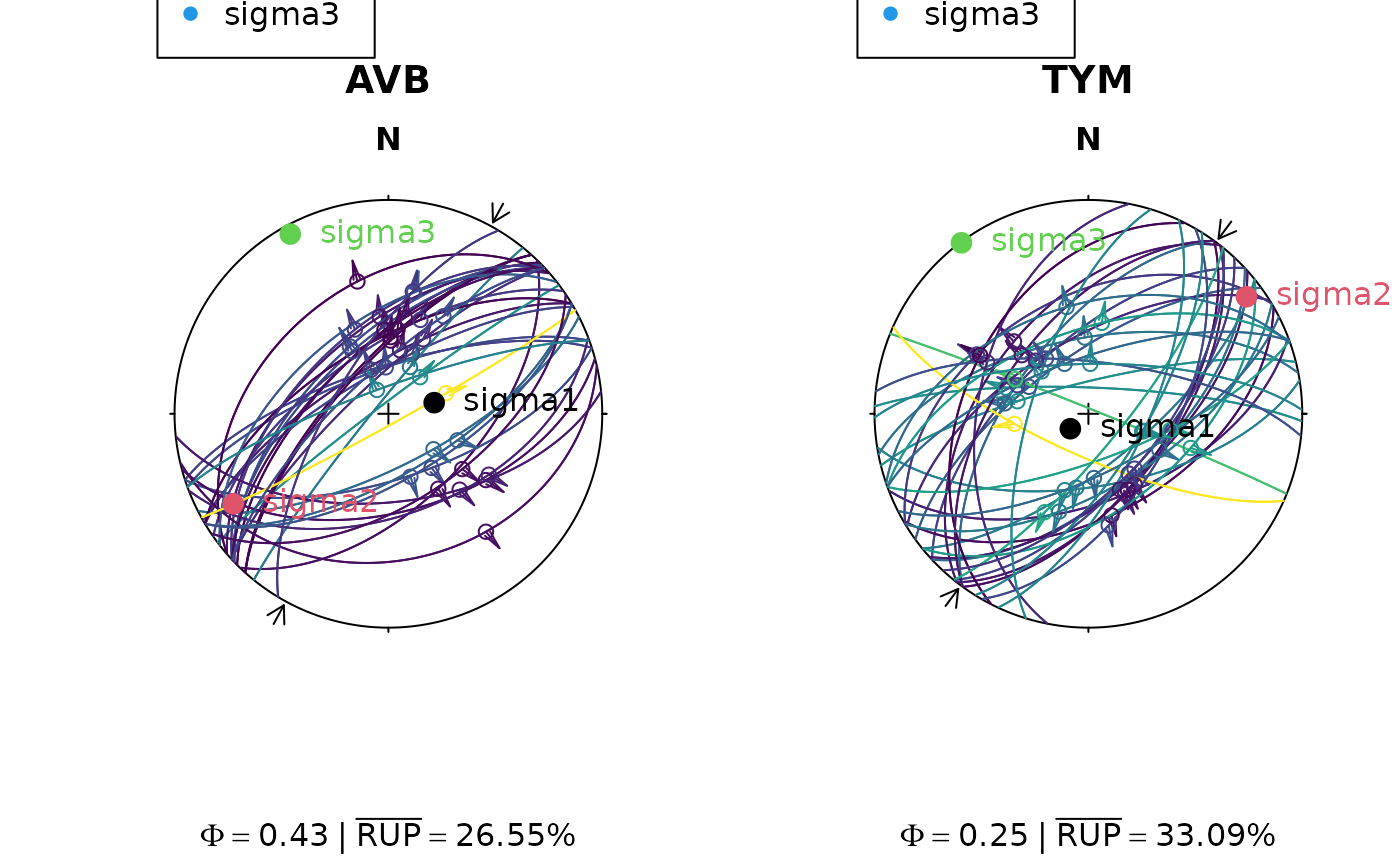
nx <- length(angelier1990)
par(mfrow = c(2, nx/2))
invisible(lapply(seq_len(nx), function(i) {
# inversion
x <- angelier1990[[i]]
res <- slip_inversion_angelier(x, max_iter = 0)
# some stress shape
phi_val <- round(res$stress_shape$phi, 2)
# misfit
rup_val <- round(res$misfit$rup_mean, 2)
# Plot the faults (color-coded by RUP%) and show the principal stress axes
stereoplot(title = names(angelier1990)[i], guides = FALSE)
stereo_shmax(res$SHmax)
fault_plot(x, col = assign_col(res$misfit$rup))
points(res$principal_axes, col = 1:3, pch = 16, cex = 1.5)
text(res$principal_axes,
label = rownames(res$principal_axes),
col = 1:3, adj = -.25
)
legend("topleft", col = 2:4, legend = rownames(res$principal_axes), pch = 16)
title(sub = bquote(Phi == .(phi_val) ~ "|" ~ bar("RUP") == .(rup_val) * "%"))
}))
 dev.off()
#> null device
#> 1
dev.off()
#> null device
#> 1